What You'll Learn in This Article
- The real reason most people can't lose weight
- What your gut microbiome actually is
- How gut bacteria control your metabolism
- The 3 hormones your gut directly controls
- What destroys your gut and locks in fat
- How to restore your gut and restart fat burning
- The natural solution that addresses the root cause
- Frequently asked questions
You've probably done everything right — cut the carbs, hit the gym, tracked every single calorie. And still, the scale won't move. You're not imagining it. You're not being lazy. And you're definitely not alone. Millions of people across the United States and around the world are stuck in the exact same frustrating loop, trying harder and harder with less and less to show for it.
But here's what almost nobody is talking about: the real reason most people can't lose weight has nothing to do with food or exercise. It has everything to do with what's happening inside your gut — specifically, the trillions of bacteria living in your digestive system that silently control how your body burns fat, stores energy, and regulates hunger.
This isn't a fringe theory. It's cutting-edge science that top metabolic researchers have been publishing about for years — and it's finally starting to break through into mainstream conversation. Once you understand this connection, everything about your weight loss journey starts to make sense.
The Real Reason Most Diets Fail
Think back to every diet you've ever tried. Maybe it worked for a few weeks. Maybe you lost some weight initially, felt hopeful, and then watched everything slowly creep back — even though you were still following the plan. That experience is so universal it's almost become a joke. But it's not funny when you're living it.
The problem isn't the diet itself. The problem is that virtually every popular diet on the market — low-carb, intermittent fasting, calorie counting, plant-based — treats weight as a simple math equation. Calories in, calories out. Burn more than you eat and you'll lose weight.
Except that's not how the human body actually works. Your body is a living, adaptive biological system — not a calculator. And when that system is disrupted at the gut level, no amount of dietary restriction is going to produce lasting results. You're essentially trying to fix a broken engine by changing the fuel grade. It might help slightly, but it doesn't address the actual mechanical failure underneath.
💡 Key Insight: Researchers at the Weizmann Institute of Science found that two people eating the exact same meal can have completely different blood sugar responses — based entirely on differences in their gut microbiome composition. This alone proves that calories are not the whole story.
What Your Gut Microbiome Actually Is
Your gut microbiome is the massive, complex community of microorganisms — bacteria, fungi, viruses, and other microbes — that live in your digestive tract, primarily in the large intestine. The number is staggering: you carry roughly 38 trillion microbial cells in your gut, which actually outnumbers your own human cells.
For a long time, scientists thought these microbes were just passive passengers — along for the ride but not really doing much. That view has been completely overturned. We now know that your gut microbiome is one of the most metabolically active organs in your entire body. It influences everything from how you digest food and absorb nutrients to how you feel emotionally and how efficiently your body burns fat.
A healthy gut microbiome is diverse. It contains hundreds of different species of bacteria, each playing a specific role. When this diversity is maintained, everything runs smoothly. When it's disrupted — when harmful bacteria crowd out the beneficial ones — the entire system starts breaking down in ways that make weight gain almost inevitable.
How Gut Bacteria Directly Control Your Metabolism
Here's where things get really interesting — and a little alarming. Your gut bacteria don't just sit there processing food. They actively communicate with your metabolism through multiple biological pathways. Think of them as metabolic regulators — they're constantly sending signals to your liver, your fat cells, your pancreas, and your brain, influencing nearly every aspect of how your body uses and stores energy.
There are several specific mechanisms through which this happens:
Short-Chain Fatty Acid Production
Beneficial gut bacteria ferment dietary fiber and produce compounds called short-chain fatty acids (SCFAs) — primarily butyrate, propionate, and acetate. These SCFAs are remarkable molecules. Butyrate in particular serves as the primary fuel source for the cells lining your colon, keeping the gut wall healthy and preventing leaky gut syndrome. More importantly for weight loss, SCFAs signal to your body to use fat for energy rather than store it. When beneficial bacteria are depleted, SCFA production drops, and your body loses one of its most powerful fat-burning signals.
Energy Extraction from Food
Different types of gut bacteria extract different amounts of energy from the same food. Certain bacteria — particularly from the Firmicutes family — are extremely efficient at pulling calories out of everything you eat. People with an overgrowth of Firmicutes relative to Bacteroidetes tend to extract significantly more calories from identical meals than people with a balanced microbiome. In practice, this means two people eating the exact same dinner can end up with vastly different caloric loads in their bloodstream — all because of the bacteria in their gut.
Gut Lining Integrity
When your gut microbiome is imbalanced, the tight junctions between the cells lining your intestinal wall can start to break down — a condition researchers call intestinal permeability, commonly referred to as leaky gut. When this happens, bacterial fragments called lipopolysaccharides (LPS) leak into your bloodstream. Your immune system responds to these fragments as though they were an infection, triggering a state of low-grade chronic inflammation. And chronic inflammation, as research consistently shows, is one of the most potent drivers of metabolic dysfunction and weight gain.
The 3 Hormones Your Gut Controls
Your gut microbiome has a direct hand in regulating three of the most important hormones related to body weight and fat storage. Understanding how this works explains why so many people feel perpetually hungry, fatigued, and unable to burn fat no matter what they try.
1. Leptin — The Satiety Hormone
Leptin is the hormone your fat cells release to tell your brain that you've had enough to eat and that you have sufficient energy reserves. In a healthy system, leptin signals act as a natural appetite brake. But when your gut is imbalanced and inflammation is high, your brain can develop leptin resistance — meaning it stops receiving those "full" signals properly. The result? You feel hungry even when you've just eaten. You crave high-calorie foods constantly. And your body never gets the signal to start burning stored fat for energy.
2. Ghrelin — The Hunger Hormone
Ghrelin does the opposite of leptin — it's the hormone that tells you you're hungry. In a healthy gut, ghrelin spikes before meals and drops afterward. But a disrupted microbiome can cause ghrelin levels to stay elevated for longer after eating, leaving you feeling unsatisfied even after a full meal. Certain gut bacteria have been shown to directly regulate ghrelin production, making the composition of your microbiome a powerful determinant of your appetite patterns.
3. Insulin — The Fat-Storage Hormone
Insulin is perhaps the most consequential hormone when it comes to fat storage. Its primary job is to move glucose from your bloodstream into your cells. But gut dysbiosis — an imbalanced microbiome — promotes chronic inflammation, which in turn impairs insulin sensitivity. When your cells become less responsive to insulin, your pancreas produces more and more of it to compensate. High circulating insulin levels send a powerful signal to your fat cells: store everything. This is why insulin resistance is one of the hallmark features of metabolic syndrome and one of the main reasons people with gut imbalances struggle so desperately to lose weight.
⚠️ Important: If you've been told you're "pre-diabetic" or have insulin resistance, there's a strong possibility that gut dysbiosis is a contributing factor — one that dietary changes alone may not fully address without also restoring gut microbiome balance.
What Destroys Your Gut and Locks In Fat
The modern lifestyle is almost perfectly designed to disrupt gut health. Consider how many of the following apply to your daily life:
- Processed and ultra-processed foods — High in refined sugars, artificial additives, emulsifiers, and seed oils that directly damage the gut lining and feed harmful bacteria while starving beneficial ones.
- Antibiotic use — While sometimes medically necessary, antibiotics wipe out large populations of beneficial bacteria and can permanently alter microbiome composition if not actively restored afterward.
- Chronic psychological stress — Through the gut-brain axis, prolonged stress alters microbial populations, increases intestinal permeability, and triggers inflammatory responses throughout the digestive system.
- Poor sleep quality — Research shows that even short-term sleep deprivation significantly alters the ratio of Firmicutes to Bacteroidetes — increasing calorie-extracting bacteria and decreasing fat-burning signals.
- Sedentary behavior — Regular physical movement directly supports microbiome diversity. A sedentary lifestyle reduces bacterial richness and promotes the overgrowth of inflammatory species.
- Chlorinated tap water and environmental toxins — Chlorine in tap water is designed to kill bacteria — including the beneficial ones in your gut when consumed regularly over long periods.
The combination of these factors — which is essentially the reality for most working adults in the modern world — creates the perfect storm for gut dysbiosis. And once your gut is out of balance, the downstream effects on your metabolism, hormones, and fat-burning capacity are profound and wide-reaching.
How to Restore Your Gut and Restart Fat Burning
The encouraging news is that the gut microbiome is remarkably responsive to change. Unlike genetic factors you can't control, your microbiome is dynamic — it shifts and adapts based on what you eat, how you live, and what you put into your body. Studies have shown measurable improvements in microbiome diversity within as little as two to three weeks of targeted intervention.
Here are the most evidence-supported strategies for restoring gut health and reactivating your body's natural fat-burning pathways:
- Increase dietary fiber diversity — Aim for 30 different plant foods per week. Each unique plant food feeds a different family of beneficial bacteria, promoting the diversity that healthy metabolism depends on.
- Incorporate fermented foods daily — Yogurt with live cultures, kefir, sauerkraut, kimchi, and miso all introduce live beneficial bacteria directly into your digestive system.
- Reduce ultra-processed food intake — Eliminating emulsifiers, artificial sweeteners, and refined carbohydrates removes the primary food sources for harmful bacteria.
- Prioritize sleep quality — Seven to nine hours of quality sleep is non-negotiable for microbiome health. Sleep is when the gut repairs, regenerates, and rebalances itself.
- Manage chronic stress actively — Meditation, breathwork, nature walks, and social connection all measurably reduce cortisol levels and protect the gut-brain axis from stress-induced disruption.
- Consider a targeted probiotic and prebiotic supplement — Diet alone can be difficult to optimize for gut restoration. A high-quality supplement combining multiple probiotic strains with prebiotic fiber provides a direct, concentrated approach to rebuilding microbiome balance.
The Natural Solution That Addresses the Root Cause
Understanding all of this science is empowering — but it can also feel overwhelming. Where do you even start when every system in your body seems interconnected? That's precisely why so many people have turned to comprehensive, gut-focused formulas that combine multiple targeted ingredients in a single daily supplement.
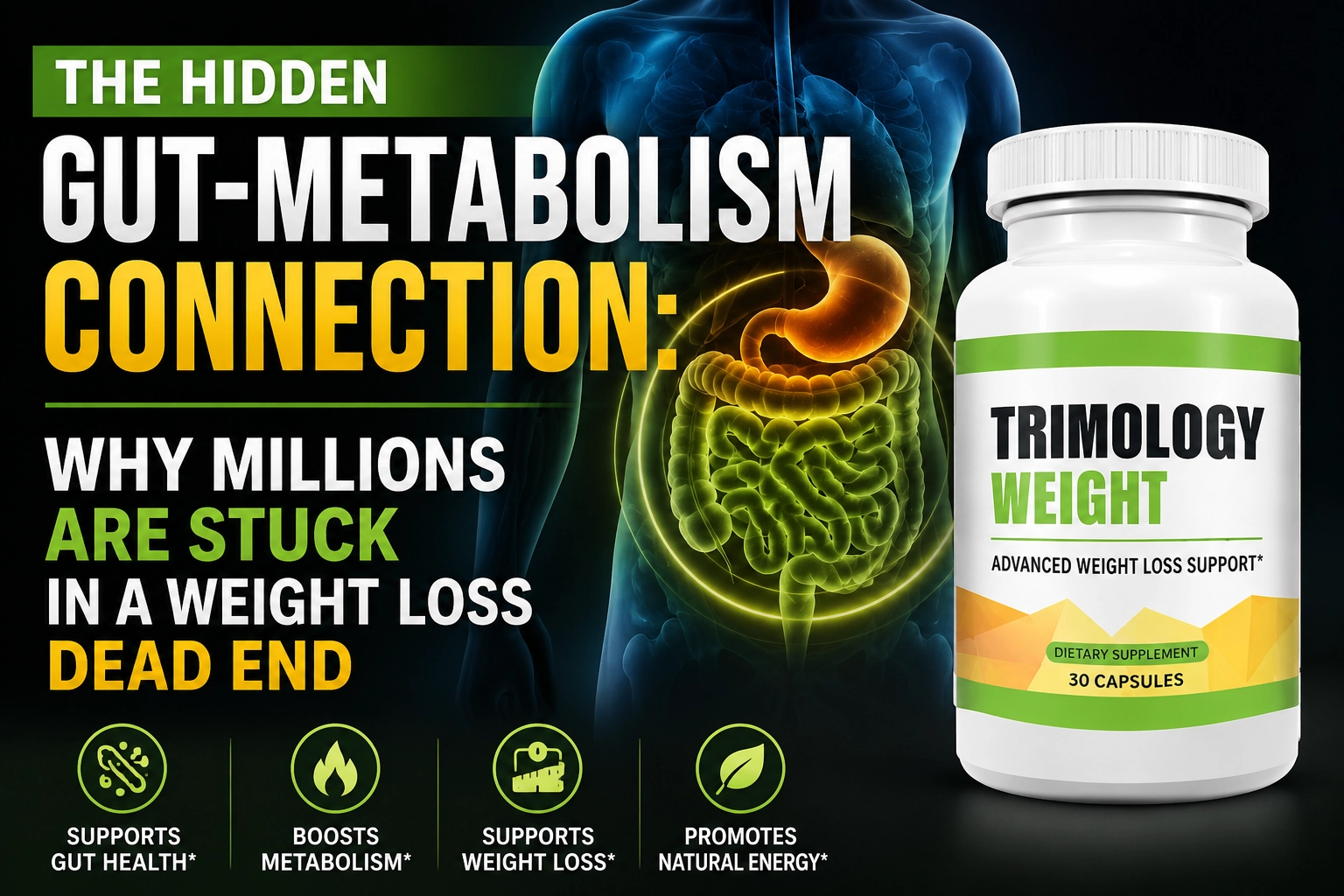
Trimology™ Natural Trim Formula was developed specifically around the science of the gut-metabolism connection. Rather than relying on stimulants or appetite suppressants that only mask symptoms, Trimology works at the biological root of weight gain — targeting the gut microbiome, reducing metabolic inflammation, and restoring the hormonal signaling pathways that make natural fat burning possible.
The formula includes a precisely selected blend of probiotic strains, prebiotic fibers, and metabolic-support botanicals — each backed by peer-reviewed research for their specific roles in gut restoration and fat metabolism. Thousands of users across the United States have reported not just weight loss results, but improvements in energy, digestion, sleep quality, and mental clarity — all downstream effects of a restored gut-metabolism connection.
🔥 Ready to Fix the Root Cause?
Trimology™ targets the gut-metabolism connection that most weight loss products completely ignore. Limited-time offer available through the official site.
Claim 70% Discount — Official Site Only✅ 60-Day Money-Back Guarantee | ✅ Free Shipping | ✅ USA Made
Frequently Asked Questions
Can fixing gut health alone cause weight loss?
Restoring gut microbiome balance is one of the most impactful steps you can take for long-term weight management. While it works best alongside a healthy diet and active lifestyle, many people report significant weight improvements from gut restoration alone — particularly in reducing inflammation-driven fat retention and normalizing hunger hormones.
How long does it take to see results from gut healing?
Microbiome shifts can happen surprisingly quickly. Research shows measurable changes in gut bacteria composition within one to two weeks of dietary changes or probiotic supplementation. However, meaningful metabolic improvements — in fat burning, energy levels, and appetite regulation — typically become noticeable between three and eight weeks of consistent effort.
Is Trimology safe for people with gut sensitivities?
Trimology is formulated with natural, non-stimulant ingredients and is generally well tolerated. However, as with any dietary supplement, we recommend consulting with your healthcare provider before starting — particularly if you have any pre-existing digestive conditions or are taking prescription medication.
What is the difference between probiotics and prebiotics?
Probiotics are live beneficial bacteria that you introduce into your gut. Prebiotics are the dietary fibers that feed and sustain those beneficial bacteria once they're there. The most effective gut-restoration approaches combine both — introducing new bacteria and simultaneously providing them with the nutrition they need to thrive and multiply.